
The Index of Industrial Production (IIP) grew by 1.4 per cent in November as most components like manufacturing, electricity, mining, primary goods, and consumer durables witnessed a slowdown, according to data released by the National Statistical Office (NSO) on Wednesday. This is on the base of a decline of 1.7 per cent in November 2020 and before the new Covid variant started impacting economic activity. IIP growth was lower than the 4 per cent expansion recorded in the previous month but was better than a 1.6 per cent contraction seen in November 2020. Separately, rising prices of kitchen staples pushed retail inflation, or rate of price increase, to 5.59 per cent in December 2021, bringing it close to the upper band of Reserve Bank's comfort zone.

Companies are already diversifying sourcing, raising prices, and reworking operating models as the disruption drags on.
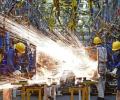
Capital goods output rose by a robust 20 per cent in the month under review as against a contraction of 2.4 per cent earlier.

A recently finalised peace deal between the US and Iran, set to be signed on June 19, is expected to significantly benefit India's economy by boosting exports to West Asia, stabilising the rupee, and easing inflationary pressures, according to exporters and experts.

The growth of eight infrastructure industries slowed down to 3.1 per cent in July, against 4.5 per cent in the same month last year, mainly due to contraction in crude oil and natural gas production.

India's industrial production growth slowed marginally to 4.9 per cent month-on-month in March 2024, mainly due to poor show by the mining sector, according to official data released on Friday. The factory output growth, measured in terms of the Index of Industrial Production (IIP), was 5.6 per cent in February 2024. However, it was 1.9 per cent in March 2023.

India Ratings and Research predicts the Reserve Bank of India (RBI) will maintain the repo rate at 5.25 per cent throughout FY27, despite potential inflationary pressures from higher fuel prices, with inflation expected to remain within the central bank's tolerance band.

During April-May, growth in the eight core industries slowed to 3.3 per cent as against 4.9 per cent in the year-ago period.

India's economic growth slowed to 7 per cent in the three months through June from 7.5 per cent in the previous quarter

Inflation in India probably edged up in October as food prices climbed while weak demand is expected to have hurt factory output growth.

With natural gas and cement showing decline in production, the growth of eight core infrastructure industries slowed down to 5.3 per cent in May against 7.4 per cent a year ago.

The core industries that also include coal, electricity, cement, petroleum refinery products and finished steel, and carry 37.9 per cent weight in the Index of Industrial Production, had grown by 5.8 per cent in May last year.

Escalating geopolitical tensions in West Asia are beginning to disrupt India's automotive supply chain, leading to rising commodity prices, logistics bottlenecks, material shortages, and pressure on consumer demand, with two-wheeler makers already raising prices.

Industrial production grows at 2.1 per cent in March.

There is record underperformance and under-ownership. Some of this is cyclical and will turn on its own. However, we also need to regain our growth credentials. For this, both the government and companies have a role to play, as do investors, points out Akash Prakash.

India's first trillion-dollar company will be built on technology it owns, not just operates, predicts Ajay Kumar.

The key question is how much of the latest growth record represents recovery from the 2020-2021 downturn, and what is the sustainable growth rate now, asks T N Ninan.
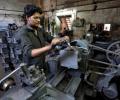
India's manufacturing sector activity witnessed the weakest improvement in the sector in two years in December on account of softer expansions in new orders, prompting firms to limit input purchases and job creation, a monthly survey said on Friday. The seasonally adjusted HSBC India Manufacturing Purchasing Managers' Index (PMI) -- an indicator of sector performance -- fell from 56.6 in November to 55 in December.
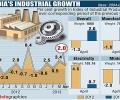
Vivek Mahajan (Head - Research) Aditya Birla Money, analysed the slow IIP growth.
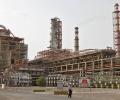
The growth rate of eight infrastructure sectors of coal, crude oil, natural gas, refinery products, fertilisers, steel, cement and electricity was 5.7 per cent in January 2016.

The output of eight key infrastructure sectors slowed down to a five-month low of 2.9 per cent in February, as against 7.1 per cent growth registered a year ago, according to official data released on Friday. On a monthly basis, the production growth of the core sectors was lower than the 5.1 per cent expansion recorded in January.

After a record-breaking year, India's automobile industry is entering 2026 on a relatively strong footing, with sales growth expected in the 6-8 per cent range. The outlook is underpinned by policy support, including GST rationalisation, easing monetary conditions, and income tax relief, which together are likely to improve affordability and sustain consumer demand across vehicle segments.
Tracking a sharp drop in industrial growth, six core infrastructure industries expanded by a disappointing six per cent in September as against 10.6 per cent a year ago. The growth for the April-September period of 2007-08 also dropped to 6.6 per cent from 8.7 per cent in the comparable period of the previous year.

Industrial production was seen growing 1.8 per cent from a year earlier in July, slower than June's 3.4 per cent increase, according to the median consensus in a poll of 31 economists.

The growth of six core infrastructure industries eased to 1.8 per cent in July, the lowest this fiscal, as petroleum refinery acted as a drag on the sector.

Bajaj Auto is planning a slow, calibrated push to take the Chetak, its electric scooter, to more than 100 countries on the strength of its distributor network and market-specific localisation rather than an aggressive global rollout, reports Sohini Das.

The growth of eight core sectors slowed down to 2.6 per cent in August mainly due to contraction in steel output.

'The real risk is not that AI will fail to transform India's economy.'
'The risk is that it already is -- while our measurement systems continue to look the other way,' observes Nishant Sahdev, a theoretical physicist at the University of North Carolina.

India's home-grown EV startups say the government's auto PLI scheme is helping big players while shutting out innovators building electric two- and three-wheelers from scratch.

India's rapidly ageing truck fleet, with 42% of vehicles over 12 years old, is set to trigger a replacement-driven growth of 3-5% annually over the next five years.

India's economy is projected to maintain growth above 7 per cent in 2026-27 (FY27), supported by strong domestic consumption and investment, even as global growth faces risks from geopolitical tensions, according to industry body Assocham.

During December 2011, the core sectors recorded a growth of 3.1 per cent against 6.3 per cent same period previous year.

The Beijing summit may have reduced immediate diplomatic uncertainty, but it did not resolve the deeper structural contest between the United States and China. That contest appears likely to define the coming decade, notes Varun Arya.

'We are targeting a 2.5x to 3x increase in valuation by FY31.'

Apple CEO Tim Cook's strategic pivot, from initial rejections to local partnerships and leveraging government policies like PLI, transformed India into a major iPhone manufacturing and export hub, now accounting for one in every four iPhones assembled globally.
The eight core sector industries have a weight of 37.9 per cent in the overall Index of Industrial Production.

The growth of six infrastructure industries slowed to 2.5 per cent in September, pulled down by contraction in output of coal and petroleum refinery.

Recent years have been turbulent for the insurance industry due to direct and indirect tax reforms, regulatory overhaul and other external pressures. The events cumulatively slowed growth rate to single digits from the high teens seen earlier.

Sector-wise, the study revealed that the core industries have witnessed virtually negative growth in headcount, with crude oil just about maintaining the employment level.

India's industrial production growth slowed to 3.8 per cent in January, while the February retail inflation at 5.09 per cent remained within the Reserve Bank's comfort zone for the sixth straight month, according to the latest government data. Growth in factory output, based on the Index of Industrial Production (IIP), slowed to 3.8 per cent in January 2024, mainly due to poor performance of manufacturing, mining and power sectors, according to the data released by the Ministry of Statistics & Programme Implementation.
